
In critical medical situations, time is of the essence. For many life-threatening conditions, rapid drug delivery can mean the difference between recovery and irreversible damage. Emergency drugs must act fast and effectively, reaching the bloodstream quickly to manage acute events.
Some notable examples include:
| Drug | Indication |
|---|---|
| Adrenaline | Cardiorespiratory arrest |
| Anaphylaxis | |
| Glucagon | Hypoglycaemia |
| Naloxone | Acute opioid/opiate overdose |
| Post-operative respiratory depression | |
| Flumazenil | Benzodiazepine toxicity |
| … | … |
In all these cases, speed and effective systemic delivery are crucial. Conventional oral tablets may not suffice, due to delayed absorption or degradation in the gastrointestinal tract.
This is where the buccal route offers a promising alternative.
Also, auto-injectors are commonly used, for certain of these indications but have certain limitations, notably in terms of their stability, their correct use and, last but not least, a fear of needles present in many people, which means that a great deal of time is lost in decision-making when urgent administration is required.
The buccal mucosa provides several advantages regarding emergency drug administration:
1. Rapid absorption: High blood flow in the area allows fast systemic delivery.
2. Avoidance of gastrointestinal degradation: Drugs bypass the acidic stomach and digestive enzymes, improving bioavailability.
3. Non-invasive and versatile administration: Tablets, films, or sprays can be used for patients who are unconscious or unable to swallow.
To develop effective buccal formulations, understanding API permeability through the mucosa is crucial. At Skyepharma, we have implemented an in vitro buccal permeability platform that allows rapid screening of API/excipient combinations.
How it works:
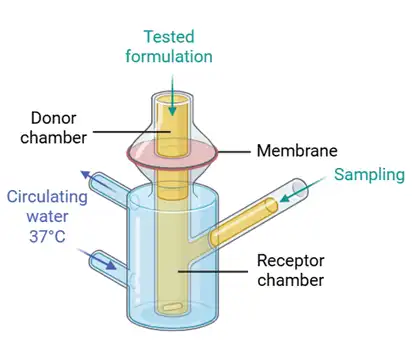
The platform uses a Franz diffusion cell (figure 1) and a synthetic membrane, Permeapad®, which mimics passive transport across the buccal mucosa.
Approximately 90% of drugs cross the mucosa via passive diffusion.
– The permeability coefficient measures how quickly a molecule diffuses.
– The permeation percentage quantifies the total fraction transported.
Both metrics are key indicators of buccal absorption potential. The platform has been validated with positive (caffeine) and negative (FITC-DEAE-Dextran) controls, according to ICH guidelines, and a proof of concept with an API demonstrated its robustness.
By evaluating buccal permeability from the earliest preformulation stages, this platform provides several advantages:
– Time-saving: Rapid identification of the most promising API/excipient combinations.
– Reduced risk: Minimized failures during clinical development.
– Cost optimization: Focus resources on combinations with the highest probability of success.
Even APIs that are stable but poorly permeable can see a significant improvement in systemic delivery with carefully selected excipients, making buccal formulations a viable strategy for emergency drugs.

– Pauline TARLET –
PhD student at Claude Bernard University Lyon 1, previously earned a master’s degree from the High School of Chemistry and Electronics in Lyon.
MucoTabs project
Skyepharma’s buccal permeability platform supports faster, smarter formulation screening for small molecules, emergency drugs, or complex delivery systems. Whether the goal is rapid systemic action or improved patient compliance, this tool helps guide preformulation decisions and ensures that development focuses on the most promising candidates.
Ready to take your emergency drug formulation to the next level? Contact us or Vanessa Bourgeaux at v.bourgeaux@skyepharma.fr to learn how our platform can accelerate your strategy and improve therapeutic impact.